
MMA betting in New Zealand: odds, offers and the one lawful door
 Available in US

Snapshot as of October 30, 2026, verified against the Racing Industry Act 2020 (section 74AAA, in force since 28 June 2025) and the Department of Internal Affairs’ current public guidance on online sports and racing betting.
New Zealand runs the tightest online sports-betting market in the developed world. There is one lawful door: TAB NZ, operating through its two online brands, TAB and Betcha. Everyone else on the screen — the offshore sportsbook with the big banner, the crypto site, the brand running boosted-odds push notifications — is serving New Zealand customers in breach of section 74AAA. That single fact reshapes the rest of this page. The interesting questions are not *who is licensed*; they are *how the odds are built*, *what a live MMA market actually looks like*, *what an offer costs the punter clearing it*, and *which of the offshore brands New Zealand players meet anyway fits a particular betting style*. The guide that follows works through those questions in that order, then closes on a side-by-side of the brands a New Zealand bettor is likely to encounter.
The angle is choice. The law closes off most of it, but inside what remains — and inside the offshore field the law targets — different brands suit different bettors. A small-stake punter who wants a Same Game Multi on a UFC main event has different needs from someone tracking live rounds with a cash-out window open. The page names who each option suits.
Live betting and cash out: how MMA markets move mid-fight
Live MMA betting is the closest thing the sport has to in-play trading, and it is where the betting site’s margin does most of its work. The market never closes the way a 1X2 football market closes at kickoff; it pulses with every takedown, every knockdown, every cut checked by the doctor between rounds.
For TAB NZ, the apps list live betting across racing codes and selected sports, and the App Store listing for “TAB – Racing & Sports Betting” describes Trackside live race streaming with in-app betting, racing form tools and a simplified wallet for deposits and withdrawals. The same app carries a 17+ age rating while stating customers must be 18 or over to bet. The mix of racing focus and sports focus is deliberate: TAB NZ is, at heart, a racing tote with a sportsbook bolted on, and the live-betting experience reflects that lineage. A New Zealand punter who wants MMA live markets through TAB NZ gets the markets the operator decides to price; any statutory restriction on in-play betting under section 74AAA is not established, so the question is what the platform itself lists rather than what the law forbids.
The offshore brands price MMA more aggressively, because MMA is one of the sports that drives handle outside the football-and-tennis mainstream. Thunderpick’s sportsbook offers a cash-out feature and markets ranging from the Champions League to the NFL, with the cash-out mechanic applicable to MMA fights the platform lists. FunBet lists live betting alongside a 24/7 bookmaker, and RTbet includes live betting in its sportsbook alongside virtual sports. Alawin and LegendPlay run Live Betting sections of their own. Glorion runs pre-match and live betting, plus virtual sports, horse racing and esports, and groups markets into popular, niche, indoor and outdoor sports, with entertainment events such as award shows and elections as separate buckets — a structure useful for a punter who likes novelty lines alongside sport.
Cash out is the bettor’s escape hatch. A punter who has backed a fighter at 2.20 and watched them eat a head kick in round one can cash out at a reduced price before the finish; a punter who has backed the other side can let it ride. The price offered is the bookmaker’s own, not the market’s, and it widens as the fight progresses because the outcome distribution narrows. Used well it is a tool; used as a habit it is a tax on indecision.
The structural problem with MMA live betting is round length. Each round is five minutes with a one-minute rest between rounds, and non-title bouts are scheduled for three rounds while title bouts can run to five. The bookmaker’s pricing model has to price the chance of a finish inside each window plus the chance the fight goes the distance, and that is harder than pricing a 90-minute football match where goals cluster. The result is wider margins and more frequent cash-out repricing than a football bettor is used to. Punters who treat MMA live betting as the main event can expect more friction than the marketing copy suggests.
Predictions, analysis and bankroll: thinking before tipping
The first honest sentence about MMA predictions is that nobody can call a winner reliably. The second is that the line between research and a tipping service is a marketing line, not an analytical one. What a punter can do is narrow the field, and that is where bankroll discipline matters more than picking the right fighter.
Tipping services, free or paid, promise an edge they cannot deliver. A punter who subscribes because a service posts a 12-3 record over a month is reading a small sample through a survivorship filter: the services that post a 4-11 month quietly rebrand or vanish, and the public-facing leaderboard is a curated one. The honest comparison is to a punter’s own record at the same price, and most recreational punters do not keep that record. The first habit a serious MMA bettor develops is a spreadsheet: date, fighter, price, stake, result, closing line. Six months in, the spreadsheet tells the punter whether their method works. Most do not want to know what it says.
Closing-line value is the most useful single concept in sports betting. A bookmaker’s price moves as money comes in, and the price available shortly before a fight begins (the closing line) is the market’s best estimate of true probability. A punter who consistently bets at a higher price than the closing line is, over many bets, beating the market; a punter who consistently bets below it is donating. Tracking closing prices for the fighters you bet on is a sharper discipline than reading any preview.
Bankroll management is the boring half of the same discipline. The standard rule is one to three per cent of bankroll per bet, which sounds timid and survives because variance in MMA is higher than variance in most team sports — one missed weight cut, one rehydration issue, one torn ACL in a takedown attempt, and the fight ends in a way the form did not predict. A punter staking ten per cent of the bankroll on a “lock” is one bad night from zero. The unit system exists because the punter is the weakest part of the betting process.
For New Zealand punters specifically, the bankroll rule interacts with the lawful-operator rule. TAB NZ has its own stake limits and account controls, including deposit limits, time-outs and self-exclusion, all listed in the TAB NZ apps. Setting those controls before placing the first bet is cheaper than setting them after the hundredth. Offshore brands, by contrast, run on their own house rules and offer no New Zealand complaints route if a payout stalls. A punter who bets offshore must treat the stake as money that may not come back, because the Department of Internal Affairs has warned that overseas operators may be in jurisdictions with minimal consumer safeguards, may not return unspent credits and may not pay out large wins.
Bet types, odds and what a winning MMA wager actually returns
MMA betting has settled into a small set of recurring markets. Knowing what each one means — and what the bookmaker’s margin on each one looks like — is the difference between betting on a sport and betting on a number.
The most common market is the moneyline: pick the fighter. Prices sit in decimal form, and a $10 stake at 1.91 returns $19.10 (profit $9.10) if the pick wins. The math is simple — return = stake × odds; net profit = stake × (odds − 1) — and the same formula governs every other single bet on the page. A combination bet multiplies the odds of the legs into one price; a two-leg multi at 1.91 and 2.40 returns $10 × (1.91 × 2.40) = $45.84 if both legs win.
Method of victory is the second market worth understanding. Pick the winner and how: decision, knockout or technical knockout, submission. Each method carries its own price, and the bookmaker’s margin across the three method-of-victory outcomes is wider than the margin across the two-way moneyline because each outcome is rarer. A punter who can read a fighter’s finish rate is reading something the margin prices against them.
Over/under rounds is the third. The line typically sits at 1.5 rounds for a three-round bout (will it finish inside round one?) or 2.5 for a five-round title bout. The bet reads the same as a totals bet in any other sport: price above or below, settle on the official round count.
Same Game Multis (SGMs) let the punter combine several markets from one fight into a single price. Fighter A to win in round one, by knockout, in over 2.5 rounds — the bookmaker quotes a combined price and the punter’s stake rides on all legs. SGMs are popular because the prices look generous; they are also where the bookmaker’s compounding margin shows up most clearly, because each leg carries its own margin and the multi multiplies them. A punter who can read individual market margins is reading SGMs with a clearer eye than the punters chasing the headline price.
For New Zealand punters, TAB NZ calls these bets by their own racing-heavy names: Multi, Same Game Multi, plus the racing-specific Win, Place, Each Way, Quinella, Exacta, Trifecta, First Four, Double, Treble, Daily Double, Running Double, Quaddie and Big6. Most of those are racing markets and do not apply to MMA; the multi and the Same Game Multi are the ones a UFC punter will use. Betcha, the second TAB NZ brand, covers horse, greyhound and harness racing plus rugby, NRL, MMA and UFC, NBA, NFL, tennis, cricket, football, motorsports and esports — so MMA is named in the coverage.
The bookmaker’s margin sits inside every price on the card. For a two-way market with decimal odds 1.90 and 1.90, the implied probabilities are 1 ÷ 1.90 = 52.63% each, summing to 105.26% — the extra 5.26 percentage points above 100% is the bookmaker’s margin, also known as the overround. The payout share (the fraction of every dollar wagered that the book returns across all outcomes) is 1 ÷ 1.05.26, or roughly 95%; the margin is the gap. A 5% margin on a two-way MMA market is an illustrative band, not a quoted price: real markets carry wider margins on method-of-victory and tighter margins on heavy-favourite moneylines. Reading the margin takes the punter’s eye off the headline price and onto what the price actually costs.
Tournaments, weight classes and how a fight night is structured
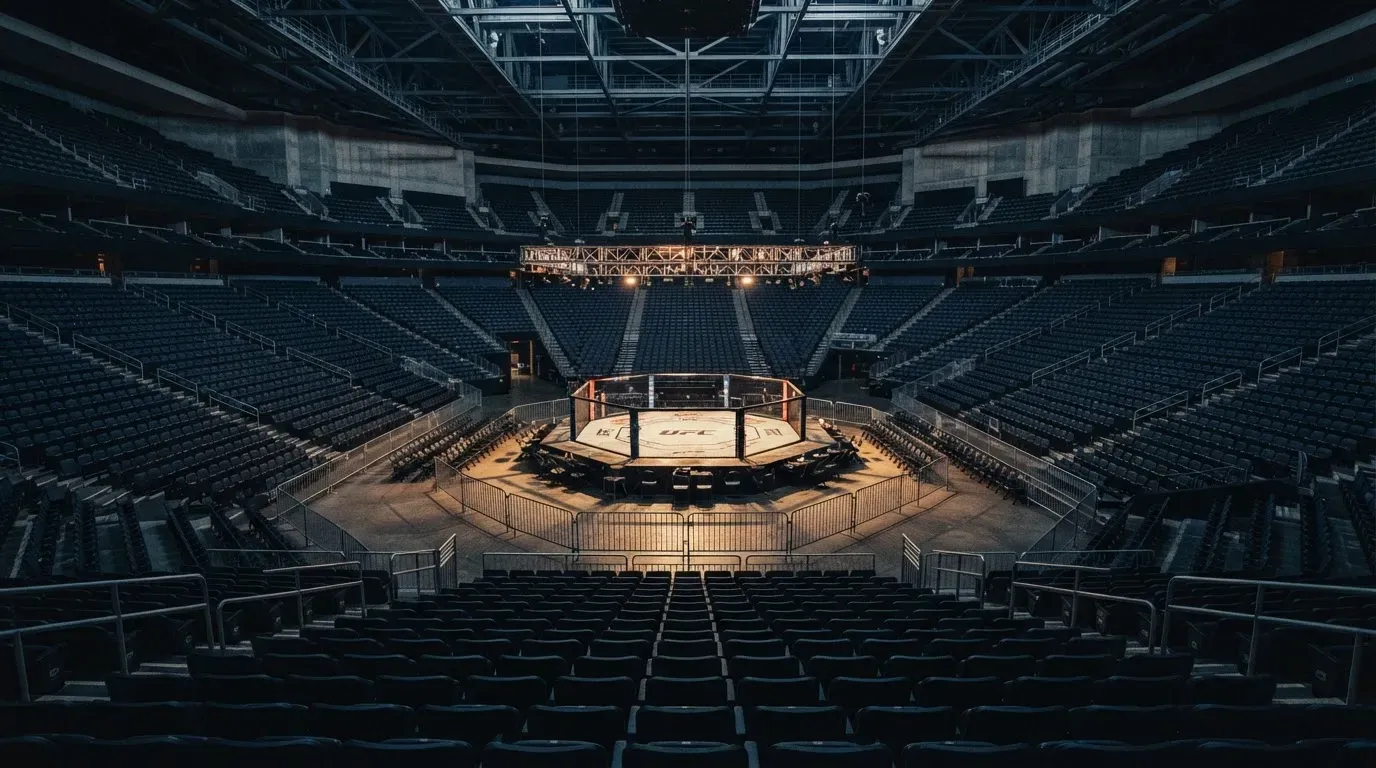
The Ultimate Fighting Championship (UFC) was founded on 12 November 1993, when UFC 1 was held at McNichols Sports Arena in Denver, Colorado. The UFC has 11 weight divisions, eight men’s and three women’s. That is the basic landscape a New Zealand punter is betting into: a single dominant promotion, a defined set of weight classes, and a calendar of numbered events plus Fight Nights that runs almost every weekend of the year.
A UFC card stacks fights by stakes. The main event and co-main event sit at the top, typically five-round bouts and frequently title fights. The undercard fills out the rest, mostly three-round bouts. Punters building a Same Game Multi on a card usually build it around the main event because the deepest markets sit there: moneyline, method of victory, over/under rounds, and “go the distance” markets are all available on the headline fights and thin out on the prelims. Betcha’s App Store listing names MMA and UFC in its sports coverage, so a New Zealand punter using the lawful operator will find the main events priced; what they will not find is the depth of exotic markets the offshore books run on smaller fights.
Other MMA promotions exist and a handful matter to bettors. Bellator runs a parallel schedule with a smaller roster and a similar ruleset. ONE Championship runs out of Asia with a different ruleset under some conditions. PFL runs a season-long tournament format with a playoff structure that creates different betting angles: a fighter needs to win multiple bouts to claim the title, so futures and outrights price the season as well as the individual bouts. None of those have the UFC’s audience, and the liquidity — and thus the margin tightness — is thinner, which is one reason bookmakers offer wider prices on non-UFC events. The wider price can be an opportunity if the punter has done the work; it is also where the bookmaker’s margin is widest.
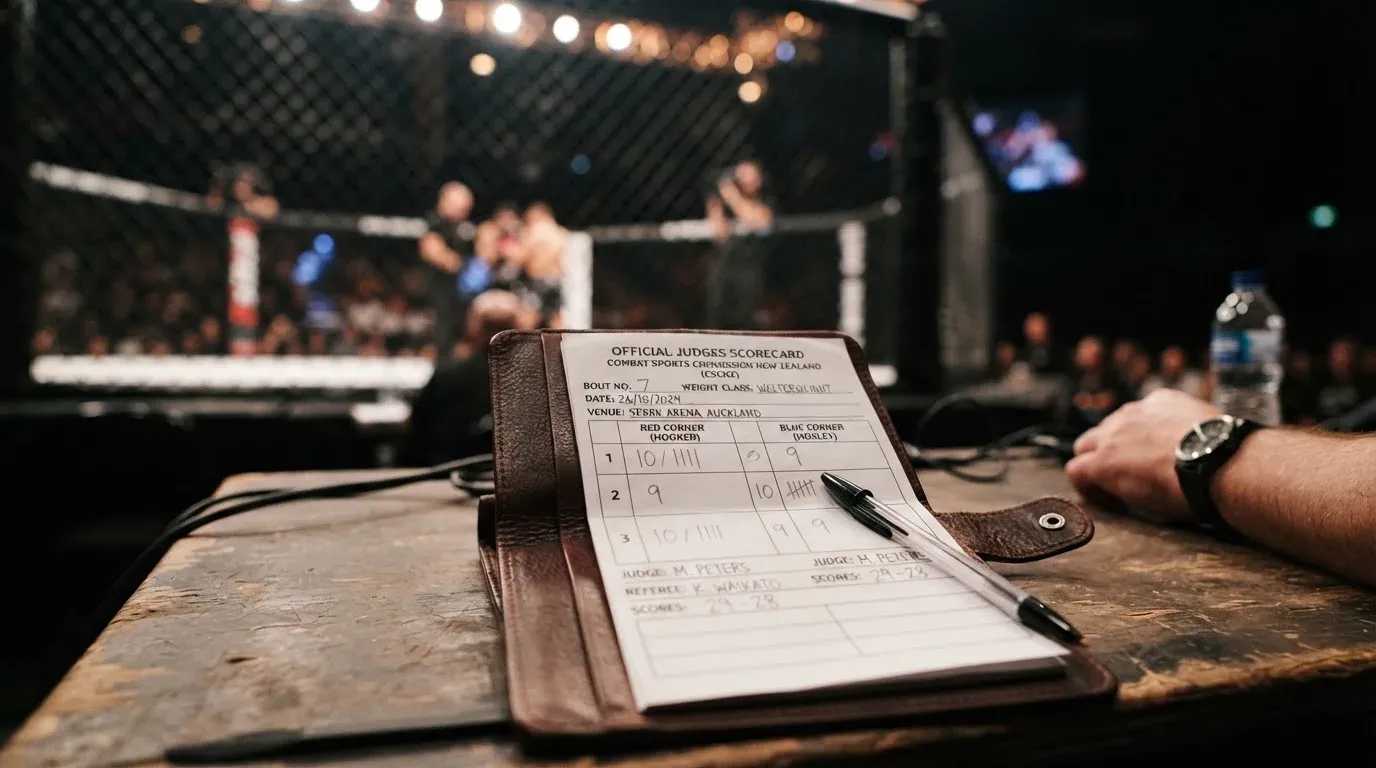
Scoring is the second piece of structural knowledge a punter needs. In MMA’s 10-point must system, three judges score each round: the round winner gets 10 points, the loser 9 or fewer, and an even round is scored 10–10. A decision can be unanimous, majority or split, and a draw can be unanimous, majority or split. Method-of-victory markets distinguish between decision, knockout or technical knockout, and submission, and the prices reflect each fighter’s history of finishes versus decisions. A wrestler who has never been knocked out and never submitted but has gone to decision in nine of ten fights is a different betting proposition from a striker whose last six fights have all ended inside the distance, even when their moneyline prices look similar.
The bout ends early under several conditions. Under the Unified Rules, a bout ends in disqualification if an intentional foul incapacitates a fighter, and in a no contest if an unintentional foul incapacitates a fighter. A bet that loses to a no-contest ruling depends on the bookmaker’s rules; most refund the stake on a no contest, but the punter must check before placing. Disqualification is its own outcome and is typically grouped with method-of-victory or settled according to the operator’s house rules.
The structural detail that matters most for New Zealand punters is the calendar. UFC runs a numbered event roughly every two to three weeks, with Fight Nights filling the gaps. The Australian and New Zealand time zones put most main events in the New Zealand morning, which is its own discipline problem: late-night punting is rarely profitable discipline. Setting a personal rule to stop placing new bets an hour before the card starts is one of the cheaper forms of bankroll management available.
Top 10 reviewed brands: the two lawful doors and the eight offshore books
The first two brands on this list are one operator. TAB and Betcha are the two online brands of TAB NZ, the only provider lawfully offering racing and sports betting to people in New Zealand under section 74AAA of the Racing Industry Act 2020, in force since 28 June 2025. TAB NZ’s partner Entain runs the TAB business under a 25-year agreement signed in 2023 that gives Entain a 50/50 share of gross profits, with at least $150m a year going to TAB NZ for the first five years, and Entain pledged a one-off $100m payment to the racing sector. The other eight are offshore brands New Zealand players meet anyway, each marked “not licensed in New Zealand” because only TAB NZ may take bets from people in New Zealand. None is ranked against another. The grouping itself is the comparison: lawful versus offshore, and what each one actually offers the New Zealand punter who reaches it.
| Brand | New Zealand status | What the operator’s own terms state on MMA |
|---|---|---|
| TAB | TAB NZ brand (one of two lawful brands) | Live betting across racing and selected sports; MMA markets available but depth varies by event |
| Betcha | TAB NZ brand (one of two lawful brands) | Covers MMA and UFC alongside rugby, NRL, NBA, NFL, tennis, cricket, football, motorsports and esports |
| Alawin | Not licensed in New Zealand | Sportsbook covers football, tennis, table tennis, basketball, ice hockey, American football and baseball; Live Betting, Virtual Sports and esports also offered |
| FunBet | Not licensed in New Zealand | Sportsbook covers football, ice hockey, American football, basketball, volleyball, tennis, rugby and baseball, with live betting and a 24/7 bookmaker |
| LegendPlay | Not licensed in New Zealand | Sports, Live Betting and Virtual Sports sections with football, tennis, basketball and ice hockey listed |
| Thunderpick | Not licensed in New Zealand | Esports-first (CS2, League of Legends, Dota 2, Valorant) with cash-out feature and markets from Champions League to NFL |
| Rabona | Not licensed in New Zealand | Soft2Bet group sportsbook launched on 23 December 2019 |
| RTbet | Not licensed in New Zealand | Football, tennis, table tennis, basketball, ice hockey, American football and baseball, with live betting and virtual sports |
| Glorion | Not licensed in New Zealand | Pre-match and live betting, virtual sports, horse racing and esports, with markets grouped into popular, niche, indoor and outdoor sports |
| BetNinja | Not licensed in New Zealand | Casino welcome of EUR 1,000 plus 100 free spins; sports offer of a 100% match up to EUR 100 on first deposit |
The columns that matter are the second and the third. The second names the legal status: TAB and Betcha are the lawful New Zealand option; the other eight are not licensed in New Zealand and serve New Zealand customers in breach of section 74AAA. The third says what each operator’s own terms put on the page, which is what a punter comparing them is actually comparing.
A punter reading the table must note that “not licensed in New Zealand” is not the same as “illegitimate brand”. Each of the offshore books is licensed somewhere — Anjouan, Curaçao, the Union of the Comoros — but those licences give no right to take bets from people in New Zealand, and the Department of Internal Affairs has told providers serving New Zealand to withdraw with immediate effect. The brand’s licence is real; its right to serve a New Zealand customer is not.
TAB (TAB NZ brand)
TAB is the original TAB NZ online brand, the tote operator New Zealanders have used in retail outlets for generations, now running under Entain’s platform. TAB NZ publishes its betting app “TAB – Racing & Sports Betting” on the New Zealand App Store under the seller name New Zealand Racing Board, with the app first released on 8 September 2014. The app covers horse and harness racing, rugby union and rugby league and other sports, pre-match and live. Trackside live race streaming sits inside the app alongside in-app betting, racing form, Blackbook and Jockey Challenge tools, and a simplified wallet.
For an MMA punter, TAB is the lawful option with full New Zealand harm-minimisation tools. The app lists deposit limits, time-outs and self-exclusion, and an exclusion applies across both TAB NZ brands. The free New Zealand Gambling Helpline (0800 654 655) and the text line 8006 are listed in the same app. The MMA market depth is the trade-off: TAB NZ prices the headline fights and the bigger Fight Nights, and the punter looking for method-of-victory lines on prelim fighters may not find them. The right reader for TAB is the New Zealand punter who wants a lawful bet, New Zealand protections, and access to mainstream MMA markets without the breadth of an offshore book.
Betcha (TAB NZ brand)
Betcha is the second TAB NZ online brand, run by Entain New Zealand Limited, and Betcha first appeared on the New Zealand App Store on 6 August 2024. Betcha is one of two brands, with TAB NZ, that may lawfully take online sports and racing bets from people in New Zealand since 28 June 2025. The Betcha app covers horse, greyhound and harness racing plus rugby, NRL, MMA and UFC, NBA, NFL, tennis, cricket, football, motorsports and esports.
For an MMA punter, Betcha is TAB’s modern sibling: a younger app with a sports-led positioning and MMA named in the marketing. The lawful status, the harm-minimisation tools and the New Zealand complaints framework are identical to TAB, because they sit on the same operator group. The difference is presentation and product mix: a punter who finds Betcha’s interface easier to navigate for MMA markets will spend their stake there; a punter who wants the racing depth will stay with TAB. The right reader for Betcha is the New Zealand punter who wants a lawful MMA bet through a sports-first interface, and who values the operator’s MMA coverage being named in the App Store description.
Alawin (not licensed in New Zealand)
Alawin runs a sportsbook that covers football, tennis, table tennis, basketball, ice hockey, American football and baseball, with Live Betting, Virtual Sports and esports also offered. The sport list does not name MMA in the home-page copy the platform publishes, so a punter reaching Alawin for MMA is reaching a brand whose stated sportsbook is built around the major team sports. Live betting exists but is not specifically framed around fight sports. The right reader for Alawin is the offshore-curious punter whose main betting interest is football or basketball and who treats any MMA market as a side bet, not the main event.
FunBet (not licensed in New Zealand)
FunBet runs a sportsbook offering odds on football, ice hockey, American football, basketball, volleyball, tennis, rugby and baseball, with live betting and a 24/7 bookmaker. Like Alawin, the home-page listing does not name MMA, so the depth of MMA markets depends on the punter’s willingness to dig. The 24/7 framing is a positioning claim — a bookmaker that takes bets at three in the morning — and that matters more for live betting across time zones than for MMA specifically. The right reader for FunBet is the punter who wants a round-the-clock bookmaker and whose MMA interest is secondary to a football or basketball main line.
LegendPlay (not licensed in New Zealand)
LegendPlay runs a sportsbook with Sports, Live Betting and Virtual Sports sections, with football, tennis, basketball and ice hockey listed. The home-page framing again puts the team sports first and does not name MMA. LegendPlay names an Anjouan Gaming Authority licence, which is not licensed to serve New Zealand. This platform suits a punter comparing Anjouan-licensed books for the team-sports markets; MMA punters ought not pick this brand on the strength of its MMA offering, because the platform’s stated sports list does not include it.
Thunderpick (not licensed in New Zealand)
Thunderpick is the only esports-first brand in this group, covering CS2, League of Legends, Dota 2 and Valorant, and its sportsbook offers a cash-out feature and markets from the Champions League to the NFL. MMA sits in the broader sportsbook alongside the major US leagues, which suggests mainstream fight markets are priced but the brand’s identity is built around esports rather than MMA. Thunderpick names a Curaçao licence (OGL/2024/677/0722), holder Paloma Media B.V., which is not licensed to serve New Zealand. It appeals to punters who want a wider esports-focused sportsbook rather than an MMA-dedicated one.
Rabona (not licensed in New Zealand)
Rabona launched on 23 December 2019 as the sixth online sportsbook of the Soft2Bet group. The platform sits inside a multi-brand operator group rather than as a standalone bookmaker, and that group structure tends to mean standardised markets and a stable promotional frame. Rabona names a Curaçao licence, which is not licensed to serve New Zealand. It is a stable choice for those already familiar with the broader Soft2Bet promotional network.
RTbet (not licensed in New Zealand)
RTbet runs a sportsbook that covers football, tennis, table tennis, basketball, ice hockey, American football and baseball, with live betting and virtual sports. Like Alawin, the home-page copy frames the sportsbook around the major team sports rather than MMA, so the MMA depth depends on what the platform prices below the home page. RTbet names a Curaçao licence, which gives no right to take bets from people in New Zealand. The right reader for RTbet is a punter whose main betting interest is the team sports the platform names, who will use MMA markets opportunistically rather than as a primary line.
Glorion (not licensed in New Zealand)
Glorion runs pre-match and live betting, virtual sports, horse racing and esports, with markets grouped into popular, niche, indoor and outdoor sports plus entertainment events such as award shows and elections. The market-grouping structure is the distinguishing feature: a punter who likes novelty lines — politics, awards, niche sports — gets a separate bucket rather than a hunt through the main sports menu. Glorion names no licence that applies in New Zealand. The right reader for Glorion is the punter who wants a broad market menu including novelty lines and who will use the niche-sports buckets for less-covered fight cards and entertainment bets.
BetNinja (not licensed in New Zealand)
BetNinja advertises a casino welcome of EUR 1,000 bonus plus 100 free spins, and a sports offer of a 100% match up to EUR 100 on first deposit. The sportsbook side of the offering is thus a smaller piece of the brand than the casino side. BetNinja names a licence from the Union of the Comoros, which gives no right to take bets from people in New Zealand. The right reader for BetNinja is the punter who lands on the brand for its casino and treats the sportsbook as a side product rather than the reason for being there.
Overview: what MMA betting in New Zealand actually is
MMA betting in New Zealand is a single-operator sport market wrapped inside an offshore field. TAB NZ, through TAB and Betcha, is the lawful route and the only one with New Zealand harm-minimisation tools, regulator oversight and a complaints framework. Everyone else on the screen is offshore and serves them in breach of section 74AAA. The New Zealand law targets the operator, not the player; section 19(4) of the Gambling Act 2003 (inserted in 2025) says an individual may not be convicted for placing a bet with an offshore operator, and no published penalty for a player was found. The honest framing is “TAB NZ and Betcha are the only lawful option, with New Zealand harm-minimisation tools, regulator oversight and a complaints framework; offshore is unlawful for the operator to serve New Zealand, no New Zealand complaints route, DIA’s stated risks, limits possible elsewhere.”
What an MMA punter is buying is access to a market with a margin built in. The book’s margin on a UFC moneyline is tighter than on method of victory, tighter still than on a Same Game Multi combining several legs. The punter who reads the margins is the punter who notices when a “boosted odds” offer is in fact shifting a price from 1.83 to 1.85 — a real improvement, but a small one. The punter who treats the boost as a gift is the punter the offer is built for.
What an MMA punter is risking is variance. Each fight carries the chance of an early finish that the form did not predict, a weight cut that goes wrong, a referee stoppage that lands awkwardly for a markets the punter has built. The right bankroll is one to three per cent per bet, the right record is a spreadsheet, and the right time to set deposit limits at TAB NZ is before the first bet rather than after the hundredth. None of that is complicated and none of it is exciting; that is why it works.
What the offshore field offers is breadth and price. The breadth is real: a Same Game Multi on a UFC Fight Night prelim is more likely to be available offshore than at TAB NZ. The price is also real: an offshore book can price a tighter line on a fighter the offshore book has researched more deeply. What the offshore field costs is recourse. The Department of Internal Affairs has warned that overseas operators may be in jurisdictions with minimal consumer safeguards, may not return unspent credits and may not pay out large wins. A New Zealand punter who bets offshore is betting without a New Zealand complaints framework and without New Zealand harm-minimisation tools.
The right read of this market is that the lawful operator is the right default, and the offshore brands are an option a punter takes knowingly. The two pages that follow — on legality and on responsible gambling — give the reader the framing to make that choice with eyes open.
Legality and regulation: who may take bets and what the law actually says
The Department of Internal Affairs (DIA) is the gambling regulator under the Gambling Act 2003 and monitors compliance with the betting prohibition. The Racing Industry Act 2020 establishes TAB NZ as the sole betting provider for racing and sports in New Zealand. The Racing Industry Amendment Act 2025 inserted section 74AAA: no person other than TAB NZ may offer racing betting, sports betting or other racing or sports betting to a person in New Zealand, regardless of where that person is resident or incorporated. The change took effect on 28 June 2025, and DIA told providers serving New Zealand to withdraw with immediate effect.
There is no licensing route for another bookmaker and no licence register for betting, because there is only one lawful operator. The law does not geo-block offshore websites; it puts liability on the offshore operator. TAB and Betcha are the two lawful online brands of TAB NZ, run by Entain under a long-term partnership: never present Betcha as a rival bookmaker. The Online Casino Gambling Act 2026 licenses online casino gambling only and does not license sports betting; TAB New Zealand winning the right to apply for a casino licence does not extend the betting monopoly. Greyhound racing is closing in stages from 1 August 2026, and from that date offshore operators may not take bets on greyhound races either.
What may be bet on is racing and sports betting from TAB NZ only. TAB NZ takes fixed-odds and tote (pool) bets; its published betting rules define bets such as Win, Place, Each Way, Quinella, Exacta, Trifecta, First Four, Double, Treble, Daily Double, Running Double, Quaddie and Big6, and Multis and Same Game Multis. Live betting is listed in the TAB NZ apps; any statutory restriction on in-play markets is not established. No lawful New Zealand betting exchange exists and spread betting is outside TAB NZ’s sports-betting definition. Bets on politics and novelty markets are not established. There is no statutory per-bet cap; limits are TAB NZ’s own terms. The ban covers events held inside and outside New Zealand. Virtual (computer-simulated) sport is treated by the 2026 online casino law as casino gambling; whether esports betting is “sports betting” under the Racing Industry Act is not established.
The age for TAB NZ betting is 18, and betting under 18 is an offence under section 89 of the Racing Industry Act 2020; land-based casinos are 20 — never merge the two. TAB NZ accounts need a verified New Zealand address and ID. TAB NZ lists deposit limits, time-outs and self-exclusion in its apps, and an exclusion applies across both TAB and Betcha. There is no single national online-betting exclusion register; the register the casino law will require is for online casinos only. TAB NZ must keep the risks of problem and underage gambling minimised and pays a Problem Gambling Levy of 0.74% (in force from 1 July 2025 to 30 June 2028).
Payments sit at the operator level. No statutory payment rule for betting accounts (card, bank, credit, prepaid, crypto) was found, and TAB NZ’s deposit methods and limits are operator-level and come only from its terms. Nothing states a rule on crypto or VPN use; account opening at TAB NZ requires a verified New Zealand address. No payment-blocking order or bank obligation was found.
Advertising is constrained because only TAB NZ may offer betting here; DIA reads the prohibition as covering promoting or taking such bets for another operator. The Advertising Standards Authority’s Gambling Advertising Code applies to betting advertisements: ads must not target children (under 14) or young people (14 to under 18), judged by context, appeal and expected audience (25% or more of the audience counts as significant where accurate data exists), must not encourage harm, and must be truthful with terms available. No New Zealand equivalent of a “whistle-to-whistle” ban for betting was found. TAB NZ runs “bonus bets” promotions; no New Zealand rule on bet-bonus size or wagering terms was found, so quote only TAB NZ’s own terms.
For the player, Inland Revenue guidance says recreational gambling winnings are generally not taxable and prize money from TAB horse, dog and trotting races is not taxable; a person who bets as a business is a different case. On the operator side, TAB NZ pays the Problem Gambling Levy (0.74%); overseas operators supplying New Zealand residents pay online gambling duty (12% of profits since 1 July 2024, 16% from 1 January 2027), but a duty being payable does not make an offer lawful. The point-of-consumption charge on offshore racing and sports bets ceased on 30 June 2026.
Since 28 June 2025 an overseas bookmaker taking sports or racing bets from a person in New Zealand is breaking New Zealand law, and the penalty for breaching section 74AAA is not stated in the section and no prosecution of an offshore bookmaker was found. New Zealand does not block bookmaker sites. The player faces no published penalty: section 19(4) of the Gambling Act 2003 says an individual may not be convicted for placing a bet with an offshore betting operator in breach of section 74AAA, and no source states a penalty for a player. The safe wording is that New Zealand law targets the operator, DIA warns players of the risks, and no published penalty for a player was found.
Responsible gambling: tools, helplines and the cheap forms of discipline
TAB NZ provides safer gambling tools in its app, namely deposit limits, time-outs and self-exclusion. An exclusion applies across both TAB NZ brands, so a self-exclusion from TAB is a self-exclusion from Betcha and vice versa. The free New Zealand Gambling Helpline (0800 654 655) and the text line 8006 are listed in the TAB NZ apps, and Safer Gambling Aotearoa runs alongside. The 17+ App Store age rating for the TAB NZ app sits against the operator’s stated requirement that customers must be 18 or over to bet; the rating is an App Store floor, not the legal age, and the legal age for TAB NZ betting is 18.
The offshore brands do not offer New Zealand harm-minimisation tools, because no New Zealand complaints route or harm-minimisation framework reaches them. A punter using an offshore book is relying on the offshore bookmaker’s own controls, which may be minimal, and on the platform’s own jurisdiction’s complaint process, which is outside New Zealand. The practical implication is that a punter who wants New Zealand harm-minimisation tools has to bet with TAB NZ or Betcha; a punter who chooses an offshore book is choosing a thinner safeguards environment.
The cheap forms of discipline are the ones that cost nothing and pay back the most. Setting a deposit limit before placing the first bet is cheaper than setting it after the hundredth. Setting a stop-loss for the week — a number above which the punter stops for the week regardless of what the card looks like — is cheaper than chasing a bad day into a worse one. Quitting while the spreadsheet is green is harder than quitting while it is red, and the punter who can do it spends less on tuition.
The Gambling Helpline (0800 654 655, text 8006) and Safer Gambling Aotearoa are the right first call for a punter who notices the betting has stopped being fun. The cost of the call is zero; the cost of waiting is the bill.
Crypto and anonymity: what the offshore crypto books actually change
A handful of offshore books — Thunderpick, RTbet and others — accept cryptocurrency, and the pitch is pseudonymous settlement and faster withdrawals. The pitch is real on its own terms and limited in the New Zealand context.
On its own terms, a crypto-funded account settles faster than a bank transfer and removes the card-issuer middleman. A punter who funds in Bitcoin and withdraws in Bitcoin is moving on a public ledger rather than through a card network. The trade-off is the volatility of the asset used to fund: a punter who wins $200 worth of Bitcoin and waits a week to withdraw may find it is now $180 worth of Bitcoin because the price moved. The ledger is also public, so the punter’s transactions are traceable by anyone with the wallet address.
In the New Zealand context, the crypto angle does not change the legal frame. Section 74AAA applies regardless of the payment method; an offshore bookmaker taking crypto-funded bets from a person in New Zealand is still serving that person in breach of the section. No payment-blocking order or bank obligation was found in New Zealand, and nothing states a rule on crypto or VPN use, but the underlying liability sits with the operator, not the payment rail. A punter who reaches an offshore crypto book is reaching the same operator, with the same lack of New Zealand complaints route and the same absence of New Zealand harm-minimisation tools.
The honest read is that crypto on an offshore book changes the mechanics of the transaction without changing the legal position of the punter or the operator. The punter who values pseudonymous settlement and can hold the crypto themselves may find the offshore crypto book a cleaner experience than a card-funded offshore book; the punter who wants New Zealand harm-minimisation tools and New Zealand recourse has only TAB NZ or Betcha.
The page’s worked example: what a margin of 5% on a tight two-way market looks like
Take a two-way market priced at decimal odds 1.90 and 1.90 — an example, not a quoted price, used because the symmetry makes the math legible. The implied probability for each side is 1 ÷ 1.90 = 52.63%. Two outcomes at 52.63% sum to 105.26%, and the extra 5.26 points above 100% is the bookmaker’s overround, also called the margin. The payout share is 1 ÷ 1.0526, or about 95%. A 5% margin on a two-way market is at the tight end of what MMA books run on moneylines and at the loose end of what football books run on Premier League 1X2 — a band, not a fixed point. Method-of-victory markets run wider because each outcome is rarer; Same Game Multis run wider still because the multi compounds each leg’s margin. The headline price understates the cost; the margin is what the punter is paying.
Frequently asked questions
How does MMA betting work?
MMA betting works by the punter picking an outcome — a fighter to win, a method of victory, whether the fight goes over or under a round line — at a price set by the bookmaker. A $10 stake at decimal odds 1.91 returns $19.10 (profit $9.10) if the pick wins. The price already contains the book’s margin, so two outcomes that must sum to 100% implied probability actually sum to a little more; the gap is the book’s edge.
How do you bet on MMA?
Start by setting a deposit limit on the TAB NZ app before placing a bet, because New Zealand harm-minimisation tools only attach to the lawful operator. Pick a market you have researched — moneyline, method of victory, over/under rounds, or a Same Game Multi. Stake one to three percent of the bankroll per bet, and record the bet in a spreadsheet with date, fighter, price, stake and result so you can see whether your method is working six months in.
How do you bet on MMA fights?
Read the form first: each fighter’s recent results, the breakdown of finishes versus decisions, any injury or weight-cut news, and the closing-line price available close to fight time. UFC cards run most weekends, with main events in the New Zealand morning, so a personal stop-rule an hour before the card prevents late-night impulse bets.
Which bookmaker may lawfully take sports and racing bets in New Zealand?
Only TAB NZ, operating through its two online brands, TAB and Betcha, under section 74AAA of the Racing Industry Act 2020, in force since 28 June 2025. Every other brand New Zealand punters meet — Alawin, FunBet, LegendPlay, Thunderpick, Rabona, RTbet, Glorion, BetNinja — is not licensed in New Zealand, and the offshore operator is in breach of section 74AAA by serving New Zealand customers; the law targets the operator, not the player.
How is the return on a bet worked out from the stake and the odds?
Return = stake × odds; net profit = stake × (odds − 1). A $25 stake at decimal odds 2.40 returns $60 (profit $35). A combination bet multiplies the odds of the legs into one price: a $10 stake on two legs at 1.91 and 2.40 returns $10 × (1.91 × 2.40) = $45.84 if both legs win, and zero if either loses.
What is the bookmaker’s margin and how can it be seen in the odds?
The margin is the gap between 100% and the sum of the implied probabilities of all outcomes on a market. For a two-way market priced 1.90 and 1.90, each side implies 52.63%, summing to 105.26%; the extra 5.26 percentage points is the margin, and the payout share is roughly 95%. A 5% margin on a two-way MMA market is illustrative; method-of-victory and Same Game Multi margins are wider.
Tennis, golf & more – footballbetsnz
Content created by the «footballbetsnz» team
