
AFL betting in New Zealand: where the bets go, what the prices mean
 Available in US

Data current as of October 30, 2026, verified against the Racing Industry Act 2020 and the Department of Internal Affairs’s public statements on online betting.
Bet types and odds: how an AFL price is set and what it pays
Australian rules football is not a sport New Zealand grew up with, but the betting on it follows the same fixed-odds logic as any other code the TAB NZ app carries. A punter picks an outcome, the bookmaker quotes a decimal price, and that price is the multiplier on the stake if the bet wins. Head-to-head, line, total, same-game multi — every AFL market on the TAB app works the same way underneath.
Head-to-head, line and total: the three prices around one game
The headline market is the head-to-head: pick the team to win the match. The TAB app lists it as AFL Winner, with three prices on a drawn game (Home, Away, Draw) and two prices when the draw is removed. Line betting, called the handicap in some books, sets a margin the favourite must beat; total points, over or under a line set by the trader, is the other market most AFL bettors use. Each carries its own margin, because the bookmaker builds profit into every quote rather than one line at the top of the screen.
A same-game multi stitches several legs from the one match — winner, total, first goalscorer, margin — into one ticket whose decimal odds multiply together. The TAB app markets these as Same Game Multis, and they read well to a casual punter because the combined price looks generous. They are not generous; they are several single-market prices rolled into one, with the margin applied at each leg. The longer the multi, the more margin sits inside it.
Futures and outrights: the season-long markets
The TAB app runs AFL futures well before round one. Minor premiership, top four, top eight, wooden spoon, the Brownlow Medal for the best and fairest player, and the Coleman Medal for the leading goalkicker are all listed, with prices that move through the year as form firms up. Most pre-season prices are wide because the field is long; a Brownlow quote at the start of the year gives a player at twenty-to-one because twenty names might plausibly win. By round twenty the same market trades at half that price if the leader has pulled clear.
Futures settle on the league’s count, not the bookmaker’s. A Brownlow Medal bet pays on the official count from the AFL; a Coleman Medal bet pays on the AFL’s leading goalkicker at the end of the home-and-away season. The TAB’s rules are the single place these definitions live, and a punter who has not read them is trusting the app to do the reading.
The margin inside an AFL price: how the bookmaker gets paid
A bookmaker’s profit is the difference between what it takes in and what it pays out, and the way it is hidden in a decimal price is the margin. The arithmetic is straightforward on a two-way market: if the true chance of each side is 50/50, fair odds are 2.00 on each side. The bookmaker quotes 1.90 on each side instead, and the gap between 1.90 and 2.00 is the margin. The same gap appears on three-way markets and on lines: every quoted price is shorter than the fair price by some slice, and the slices across all outcomes sum to the market’s margin.
For the AFL, a rough worked example on a head-to-head with the draw eliminated and decimal odds of 1.90 on each side gives a margin of about 5.3%. On a three-way match result with a draw priced at, say, 1.90/2.80/1.90, the margin sits closer to 7%. Same-game multis stack these margins leg on leg, so a four-leg multi at modest single prices can carry a combined margin above 15%. The number is not published on the betting slip; it is the share of every dollar bet that the bookmaker keeps on average across the market. A reader who wants to see it can divide one by the sum of the reciprocals of the decimal odds.
The calculation is a statistical estimate, not a guarantee of how any individual bet will resolve. A two-way market at 1.90/1.90 sits in the band of an ordinary pre-match head-to-head; smaller head-to-heads, three-way match results, exotic markets and same-game multis sit above it. The page treats it as a benchmark, not as a number any reader can expect to find on a specific fixture.
Sports and tournaments: the AFL in the betting app
AFL sits inside the TAB NZ app alongside rugby union, rugby league, the football codes, basketball and racing. The punter does not need a separate account to back a Brownlow Medal hopeful or a Brisbane-Geelgeew game; the same wallet and the same betting slip work on every code. A short guide to what the AFL market looks like through that window, the way the fixtures land and how the season is built, follows.
The league, the teams and the season
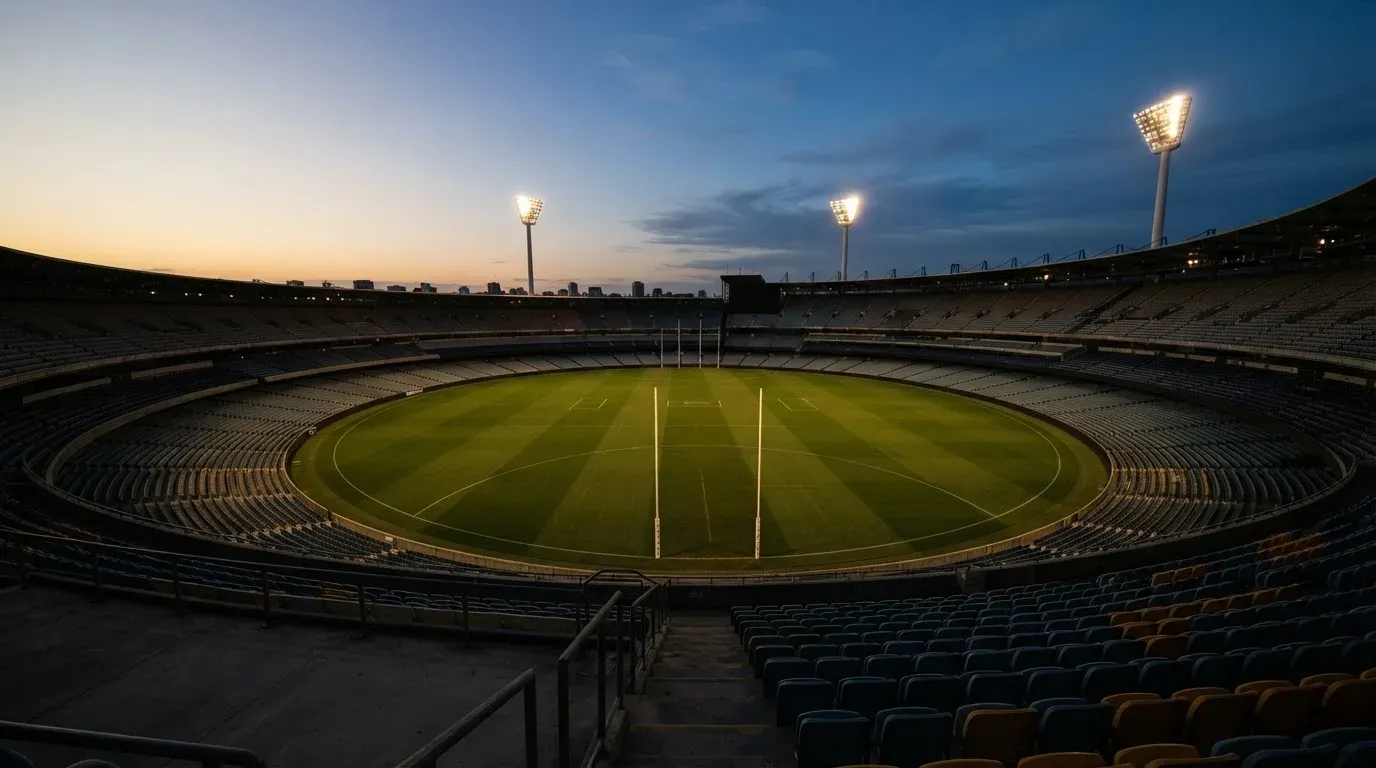
The AFL has 18 teams in 2026 — Adelaide, Brisbane, Carlton, Collingwood, Essendon, Fremantle, Geelong, Gold Coast, GWS, Hawthorn, Melbourne, North Melbourne, Port Adelaide, Richmond, St Kilda, Sydney, the West Coast Eagles and Western Bulldogs — with Tasmania due to join as the 19th team in 2028. The 24-match home-and-away season runs roughly March to September, with each club playing the others twice in a season where the draw is uneven. The five-round finals series follows, finishing in the grand final at the Melbourne Cricket Ground on the last Saturday of September.
The points system is a quirk worth knowing for anyone betting on a total. A goal scores six points and a behind scores one, so a final score of 18.14 (122) means 18 goals and 14 behinds. Scores finish in the 70-120 range more often than not, which is why the TAB’s over/under lines on AFL totals sit around the 160-mark for combined score, sometimes higher for a blowout. A punter who has only bet on rugby or basketball brings a wrong feel for the numbers; the lines look high until you have watched a couple of games.
Premierships, champions and the records that drive futures
The premiership is what the AFL means by its title, and three clubs — Carlton, Collingwood and Essendon — share the record at 16 each. Brisbane sits a step behind on three consecutive premierships after 2026, a run that started with the 2025 win over Geelong at the MCG (18.14 (122) to 11.9 (75)). The Coleman Medal, the goal-kicking prize, and the Brownlow Medal, the best and fairest, are the two individual futures the TAB app always carries.
Records and recent form drive futures contracts. A club on a long premiership drought attracts longer Brownlow-winning quotes because fewer stars mean fewer votes to spread; a hot favourite for the Coleman looks short on the line at the TAB app once its spearhead has a four-goal buffer in mid-season. The same logic applies to minor premiership and top-four markets, where ladder position in the second half of the season compresses the field.
What the season looks like through the TAB NZ app
Round one of the 2026 season started on 5 March and the grand final on the last Saturday of September. A typical Saturday round offers 4-9 matches across the afternoon and evening in Australian time, which puts most games in the New Zealand afternoon. The TAB app runs head-to-head, line, total, first goalscorer, leading at quarter time, highest scoring quarter and Same Game Multis on every game, plus futures on the Brownlow and Coleman throughout the year.
The grand final is the betting peak of the year. The TAB app opens head-to-head, line, total, margin, first goalscorer and Same Game Multis several days out, with prices tightening as the teams are confirmed. The volume on the one game dwarfs a round; for the punters who watch AFL casually, it is the only match all year they bet on, and the TAB app is set up to handle that.
Bookmaker ranking and comparison: the brands a New Zealand punter sees
The page ranks bookmakers on the same set of matters for every brand, with one hard split: TAB and Betcha are the two lawful options in New Zealand, and the rest are reference entries for an international audience. A New Zealand reader cannot legally bet with the reference set, and the ranking carries that across rather than papering over it. The matters are New Zealand status, licence (the operator’s own claim where one is named), market coverage and pricing where research carries the figure, and the operator’s own published terms on key points. Ten brands, ten rows, the same column set.
The landscape: TAB NZ brands first, then brands without a New Zealand licence
The first two brands, TAB and Betcha, are the only online sports and racing bookmakers lawfully available to people in New Zealand since the Racing Industry Amendment Act 2025 took effect on 28 June 2025, under section 74AAA of the Racing Industry Act 2020. They are two brands of one operator group, never rivals; the Department of Internal Affairs confirmed the change and told providers serving New Zealand to withdraw with immediate effect. Betcha runs as the digital-first sister site to TAB, with the same wallet and the same rules.
Every other brand in the table sits outside that frame. Some are large international sportsbooks with thousands of events and a long licence history in other jurisdictions; none holds a right to take bets from a person in New Zealand. The page keeps them in the ranking because a New Zealand reader meets them through advertising, search results and word of mouth, and describing them honestly is a service. The honest description ends with the licence line: not licensed in New Zealand, no New Zealand complaints route, and the operator’s own published rules apply to disputes.
| Brand | New Zealand status | Licence | Markets & pricing (operator’s own terms) |
|---|---|---|---|
| TAB | TAB NZ brand — one of two operators lawfully offering racing and sports betting to people in New Zealand under section 74AAA of the Racing Industry Act 2020 (in force 28 June 2025) | Sole betting operator; no licence register because there is only this one lawful provider | AFL head-to-head, line, total, multi, futures on Brownlow and Coleman; Same Game Multis on every match; full 2026 season on the app |
| Betcha | TAB NZ brand — the digital-first sister to TAB, same operator group | Sole betting operator; same section 74AAA frame as TAB | AFL markets same as TAB for the season; live betting on every game; Same Game Multis and futures |
| Telbet | Not licensed in New Zealand | Names no licence that applies in New Zealand | Sportsbook with AFL and other codes; crypto-led sign-up |
| BetNinja | Not licensed in New Zealand | Names a Union of the Comoros licence; gives no right to take bets from people in New Zealand | Sportsbook with AFL, casino under one account; 18+ |
| Golden Panda | Not licensed in New Zealand | Names no licence that applies in New Zealand | Sportsbook with esports, virtual sports, prediction markets; casino, live casino, crash games |
| RTbet | Not licensed in New Zealand | Curaçao licence; gives no right to take bets from people in New Zealand | Football, tennis, table tennis, basketball, ice hockey, American football, baseball; live and virtual |
| 22Bet | Not licensed in New Zealand | Curaçao licence (8048/JAZ, holder TechSolutions Group N.V.); gives no right to take bets from people in New Zealand | 30+ market types per event including 1X2, Double Chance, totals, both teams to score, correct score, HT-FT; tennis game, set and handicap markets |
| Rabona | Not licensed in New Zealand | Curaçao licence; gives no right to take bets from people in New Zealand | Soft2Bet group brand launched 23 December 2019; sportsbook and casino |
| LegendPlay | Not licensed in New Zealand | Anjouan Gaming Authority licence; gives no right to take bets from people in New Zealand | Sports, live betting and virtual sections; football, tennis, basketball, ice hockey |
| BetAlright | Not licensed in New Zealand | Names no licence that applies in New Zealand | Football, tennis, table tennis, basketball, ice hockey, American football, baseball; live and virtual |
A reader scanning the table sees the shape: two New Zealand-licensed brands and eight without. The page ranks on the matters research named — what the operator’s own terms state on the key’s subject — rather than on the price the brands happen to quote at any one moment. Prices age fast; the licence frame does not.
Overview: the AFL betting market in New Zealand
The page opens on what the AFL is as a betting product and where the bettor meets it. The competition sits a long way from New Zealand in distance, in culture and in calendar. The TAB app carries it because enough punters want it on the slip, not because the AFL is a New Zealand sport, and the market list of TAB NZ comes only from its own terms. A primer on what the AFL looks like through the TAB app, the way the season is built and the kinds of bets that sit on a Saturday afternoon, follows.
The AFL competition as a betting product
The AFL is a winter-spring competition in the southern hemisphere, which means the home-and-away season runs while the All Blacks are also in action and the NRL is in mid-season. A New Zealand punter with a TAB account has AFL on the same slip as rugby union, rugby league, harness racing, football and the rest. The app’s role is to carry the sport, not to curate it; the markets are standard, the rules are standard, the odds are the TAB’s own.
Most AFL bets in New Zealand are placed on the grand final, the Brownlow Medal count, and a handful of marquee Saturday matches through the season. Casual punters do not follow the ladder; they pick a team by jersey and back it once a year. The TAB app caters for that with simple head-to-head markets and a Same Game Multi builder that lets the casual punter combine winner, margin and total into one ticket. None of that makes the casual bettor sharp — it makes the bookmaker’s job easier.
The basics an AFL bettor needs to know
Australian rules football is played on an oval field with 18-a-side, four quarters of 20 minutes each, and a points system that scores six for a goal and one for a behind. A team that kicks 18 goals and 14 behinds finishes on 122 points; the grand final result in 2025, Brisbane 18.14 (122) over Geelong 11.9 (75), is the canonical example. The pace is high, the scores are high, and the matches move quickly enough that the in-play product on the TAB app is busy on a Saturday afternoon.
The betting basics for an AFL game are the same as for any sport on the TAB app. The punter logs in, picks the match from the schedule, chooses a market, enters the stake, confirms the slip. The decimal odds on the slip are the multiplier on the stake if the bet wins; a winning $10 bet at 1.90 returns $19 (the original $10 stake plus $9 profit). The betting slip is the contract; the TAB’s published rules describe how each market is settled and what counts as a void.
The TAB NZ app and how it carries AFL
The TAB NZ app, listed on the New Zealand App Store under the seller name New Zealand Racing Board and first released on 8 September 2014, carries AFL pre-match and live. The app is rated 17+ on the App Store while stating that customers must be 18 or over to bet, and an account opening requires a verified New Zealand address and ID. Trackside live race streaming with in-app betting, racing form, Blackbook and Jockey Challenge tools, and a simplified wallet for deposits and withdrawals are part of the app’s package.
The AFL sits in the app’s sports section under Australian rules. Live betting is available, with prices updating through the match and a settled bet locking at the price and line at the moment of placement. In-play markets on the TAB app for AFL include the next goal, the leader at the next break, total points at the next break, and Same Game Multis. The product is full but not deep: there is no player-prop market on every game, and the TAB app does not run a betting exchange.
Legality and regulation: the New Zealand frame around the market
The New Zealand frame around sports betting is the tightest in the developed market. TAB NZ is the sole provider of racing and sports betting to people in New Zealand, the Department of Internal Affairs enforces the prohibition, and the only way to bet lawfully is to open an account with TAB or Betcha. The page describes the frame so a reader knows what the licence line in the comparison table means, and what an offshore brand can and cannot do.
The statute: who may offer betting in New Zealand
The Racing Industry Act 2020 establishes TAB NZ as the sole betting provider for racing and sports in New Zealand. The Racing Industry Amendment Act 2025 inserted section 74AAA into that Act: no person other than TAB NZ may offer racing betting, sports betting or other racing or sports betting to a person in New Zealand, regardless of where that person is resident or incorporated. The change took effect on 28 June 2025, and the Department of Internal Affairs told providers serving New Zealand to withdraw with immediate effect.

There is no licence to apply for and no licence register for bookmakers, because there is only one lawful provider. The law does not geo-block offshore websites — New Zealand does not filter DNS or block payments — but it puts liability on the offshore operator. An offshore bookmaker that takes a bet from a person in New Zealand is breaking the law, and the Department of Internal Affairs is the regulator that monitors compliance under section 92A of the Act.
TAB NZ and Entain: the partnership that runs the only lawful operation
The TAB business runs under a 25-year agreement Entain signed in 2023, with Entain taking a 50/50 share of gross profits and at least $150 million a year going to TAB NZ for the first five years. Entain also pledged a one-off $100 million payment to the racing sector. The partnership gives TAB NZ a long-term technology and platform partner and gives Entain a stake in the only lawful sportsbook in a developed market. TAB and Betcha are the two online brands that come out of that partnership; they share wallets, rules and account infrastructure.
The partnership is one operator group, not two. Presenting Betcha as a rival bookmaker to TAB is wrong; the brands are sister apps inside the TAB NZ account. A punter who opens an account at TAB has the same wallet on Betcha and vice versa, and self-exclusion across TAB NZ applies across both brands.
What the law means for an offshore brand
Since 28 June 2025, an overseas bookmaker taking sports or racing bets from a person in New Zealand is breaking New Zealand law. The Department of Internal Affairs’s statement put providers on notice; the section’s penalty is not stated, and no prosecution of an offshore bookmaker has been published. New Zealand does not block bookmaker sites, so the brand’s site and app remain accessible; the breach is on the operator, not the player.
For the player, section 19(4) of the Gambling Act 2003 (inserted in 2025) says an individual may not be convicted for placing a bet with an offshore betting operator in breach of section 74AAA. No published penalty for a player was found. The honest framing is the one the Department uses: New Zealand law targets the operator; the Department warns players of the risks; no published penalty for a player was found. Betting offshore is not illegal for the player under the published text, and it is not advertised as safe.
What the law means for the player
A player who bets with TAB or Betcha bets inside the New Zealand frame: a New Zealand-licensed product, New Zealand harm-minimisation tools, regulator oversight, and a complaints route. A player who bets with an offshore brand bets outside that frame: no New Zealand complaints route, the operator’s own rules on disputes, and the Department of Internal Affairs’s stated risks — that an overseas operator may not return unspent credits, may not pay out large wins, and may sit in a jurisdiction with minimal consumer safeguards. The honest comparison is not that one is safe and the other is dangerous; it is that one is inside a New Zealand framework and the other is not.
The age for TAB NZ betting is 18; betting under 18 is an offence under section 89 of the Racing Industry Act 2020. Land-based casinos are 20; the casino age and the betting age are different rules and never the same. The Online Casino Gambling Act 2026 licenses online casino gambling only and does not extend the betting monopoly — TAB NZ winning the right to apply for a casino licence does not change who may take a sports bet in New Zealand.
Responsible gambling: the tools the TAB NZ app puts in place
The New Zealand harm-minimisation frame around sports betting is narrower than in a market with multiple licensed bookmakers. TAB NZ carries the responsibility because TAB NZ is the only lawful option, and the app’s safer-gambling tools are the in-product expression of that responsibility. The page describes the tools so a punter knows what is on the app before opening an account, and where to go if the tools are not enough.
The TAB NZ app’s safer-gambling tools
The TAB NZ app lists deposit limits, time-outs and self-exclusion as its safer-gambling tools. A deposit limit caps the amount a punter can put into the wallet in a chosen period; a time-out is a short break when the account cannot place bets; a self-exclusion closes the account for a longer period and is the strongest of the three. An exclusion on TAB NZ applies across its brands, so a punter who excludes on TAB is also excluded on Betcha.
The TAB app also lists the free Gambling Helpline on 0800 654 655 and the text line on 8006. The Gambling Helpline is staffed by counsellors who understand New Zealand harm-minimisation frameworks; Safer Gambling Aotearoa is the harm-minimisation body. The Department of Internal Affairs’ role is to enforce the betting monopoly and the Gambling Act 2003, not to counsel individual punters, so the help the punter reaches is the helpline rather than the regulator.
The cost of gambling harm in New Zealand
TAB NZ pays a Problem Gambling Levy of 0.74%, in force from 1 July 2025 to 30 June 2028. The levy funds harm-minimisation services, including the Gambling Helpline, treatment services and research. The levy is operator-side, paid by TAB NZ out of its gross profit, and is not a charge on a player’s stake or winnings. A punner who sees the levy on the TAB app’s terms is seeing the contribution the operator makes to the harm-minimisation system that supports them.
The cost is small in the context of the operator’s economics and large in the context of the harm it pays to address. The page carries the figure because it is the operator’s published contribution to the system, not as a judgment on whether the levy is the right size.
The offshore side: what is missing when the punter bets outside the frame
An offshore brand does not run the New Zealand safer-gambling tools. There is no deposit limit in New Zealand dollars against a New Zealand budget; no time-out that the New Zealand regulator can enforce; no self-exclusion that propagates to other offshore brands the punter might use. The punter’s harm-minimisation is the punter’s problem when the operator is not in the New Zealand frame.
The Department of Internal Affairs warns players of the risks of betting with an overseas operator. The warnings are not a moral judgment; they are a description of what is missing. A punter who bets outside the frame accepts that no New Zealand body will recover unspent credits, no New Zealand body will enforce a payout dispute, and no New Zealand body will require the operator to run the harm-minimisation tools the TAB app carries.
The greyhound transition and what it means for racing bettors
Greyhound racing is closing in stages from 1 August 2026, and from that date offshore operators may not take bets on greyhound races either. The Racing Industry Amendment Act 2025 closes greyhound racing in New Zealand, and the offshore prohibition extends to greyhound bets once the closure date passes. A New Zealand punter who bets greyhounds on the TAB app today bets them on a sport that is closing; the TAB’s greyhound markets will close as the closures land.
The greyhound closure is not the AFL, and the page notes it only because the prohibition under section 74AAA runs across racing and sports. A punter who bets only on the AFL does not face the closure directly, but the prohibition that protects the TAB monopoly on sports also underwrites the greyhound ban on the racing side.
Bonuses and free bets: what the marketing words cost
TAB NZ runs “bonus bets” promotions. The page does not print a working offer because advertising the offers the page describes is not the page’s job; the description is. The shape of every TAB NZ promotion is the same: a token amount credited to the wallet as a bonus bet, with the operator’s own terms on minimum odds, expiry and what counts as a win. The page describes that shape because the terms change the value.
What a bonus bet actually pays
A bonus bet is the operator’s marketing name for a free bet. The TAB’s bonus bet is a token the punter uses instead of cash on the betting slip. A bonus bet of $10 at 1.90 wins $9 of profit if the bet wins — the same as a $10 cash bet at 1.90, except the original $10 stake is not paid back. The punter who bets the bonus bet keeps the $9 profit, not the $9 profit plus the $10 stake. The value of a $10 bonus bet at 1.90 is the profit divided by the odds, which is $4.74 on average.
The arithmetic is what the bonus bet is worth on average, not what it wins. A punter who takes a bonus bet at long odds and wins makes more than a punter who takes the same bonus at short odds and wins, because the long odds multiply a smaller stake into a bigger payout. The average hides the variance; a single bonus bet at 5.00 either wins $40 or nothing. The marketing word “free bet” is not free in the punter’s pocket; the stake is the operator’s.
The minimum odds and the expiry that change the value
The TAB app’s bonus bet terms carry a minimum odds requirement and an expiry. The minimum odds stops the punter from using the bonus bet on a 1.01 line — a near-certain winner that might, if it won, pay almost nothing in profit — and pushes the punter toward markets where the bookmaker’s margin is larger. The expiry stops the punter from holding the bonus bet indefinitely and forces it onto a slip the operator wants action on. Both are operator-side levers; the punter either accepts them or does not claim the offer.
The minimum odds and the expiry together describe what the bonus bet is worth on average. A $10 bonus bet with a 1.50 minimum odds and a 7-day expiry is worth more than the same bonus with a 5.00 minimum and a 24-hour expiry, because the punter has more markets to use it on. The page does not name the TAB’s current minimum and expiry because research carries no figure; the description is the shape.
The rollover that turns the bonus into something else
Some TAB promotions credit a bonus that the punter must roll over before it can be withdrawn. The rollover is the wagering requirement: the punter bets the bonus amount (or the bonus plus the deposit) a set number of times at minimum odds before the bonus is converted to cash. A bonus with a 1x rollover at minimum odds converts on the first bet; a bonus with a 5x rollover at minimum odds takes five bets to convert.
The rollover changes the cost of the bonus. A $10 bonus with a 5x rollover at 1.50 minimum odds requires $50 of bets at margins of around 5% on ordinary markets; the expected cost of clearing the rollover is about $2.50, which means the bonus is worth about $7.50 once the punter has done the rollover. The marketing word “bonus” hides this arithmetic; the punter’s job is to do it before claiming the offer.
Predictions and strategy: what a model can and cannot tell the punter
The page does not predict the Brisbane-Geelgeew result in 2027 or name a “best bet” for Saturday. A prediction in a betting context is a forecast with money behind it, and a punter who acts on the page’s prediction loses real money when the forecast is wrong. The page describes how to think about predictions and what a model can and cannot do, because the analytical approach is the part the punter can carry forward.
What a forecast is and what a bookmaker’s price already says
A forecast is a probability estimate of an event, dressed as a tip. A bookmaker’s price is also a probability estimate: the fair odds on a coin toss are 2.00, so a fair price on a 50/50 event is 2.00. The bookmaker’s quoted price is shorter than the fair price by the margin, and the gap between the quoted and the fair is the bookmaker’s edge. A punter’s job is to find prices that are longer than the punter’s estimate of fair — the punter thinks the team is 60% to win, and the bookmaker’s price implies 55%, so the price is value to the punter.
The model is the analytical core. A model takes inputs — recent form, head-to-head, venue, injuries, weather, line-up news — and outputs a probability. The bookmaker’s price is another model output, and the punter backs the model that the punter thinks is sharper. The page cannot tell the punter which model is sharper because the page has not seen the punter’s data.
Why “best bets” pages age badly
A “best bet” is a tip with a price attached. The page describes what a tipster is selling rather than what a tipster knows, because a tip is an opinion and an opinion is cheap. A tipster’s record is the average return on the tipster’s tips at the tipster’s quoted prices, and a tipster who is consistently profitable is rare. Most tipsters lose to the bookmaker’s margin because most tipsters do not have an edge.
The “best bets this week” pages that rank tipsters by recent return measure the wrong thing. A tipster who picked the last three winners is not necessarily sharper than a tipster who picked the last three losers; variance is large at small samples. The honest tipster publishes the long-run record; the dishonest tipster publishes the recent run. The punter’s job is to read the long-run record and decide whether the tipster is in the small profitable minority.
The bankroll framework: staking without going broke
The bankroll is the punter’s budget for betting, separate from rent, food and savings. A punter who bets 5% of the bankroll on one event has a longer run than a punter who bets 25%; the larger the stake as a share of the bankroll, the larger the variance and the faster the bankroll can blow out. A punter who bets 1% of the bankroll per bet has the longest run, and a punter who bets 10% per bet has the shortest. The bankroll framework is the punter’s risk management; the picks are the punter’s picks.
The framework extends to a single day’s betting. A punter who has three bets on a Saturday afternoon has a stake plan that limits the day’s spend to a share of the bankroll. The stake plan does not have to be flat; a punter who thinks one bet is sharper than the others can stake more on the sharp one. The plan is what the punter agreed before the bets went on, and the punter who sticks to the plan is the punter who survives the losing streak.
The closing-line discipline: why the price the punter takes matters
The closing line is the price on the betting market just before the event starts. A punter who takes a price earlier in the week and the price moves against them has backed a worse price than the market’s last word, while the reverse is true if the price moves in their favour. The discipline is to back the price the punter thinks is right when the punter sees it, and to log the bet.
The closing-line discipline matters because a sharp model is a model that beats the closing line. The model that picks prices better than the market at kick-off has an edge; the model that picks prices worse than the market at kick-off has a disadvantage. The discipline is the only honest test of whether the punter’s picks are sharp.
The brands in detail
The page now closes the operators the plan routes into the ranking, with the same matters the table carries: licence, market coverage, the operator’s own published terms, and the page’s verdict on what the brand suits. Two brands carry a New Zealand licence; eight do not, and the eight are kept because a New Zealand reader meets them and the page describes them honestly. A verdict at the close of each block is the page’s own judgement, not the operator’s marketing.
TAB
TAB is one of the two online brands of TAB NZ, the sole betting operator for racing and sports in New Zealand under section 74AAA of the Racing Industry Act 2020. The TAB app carries AFL pre-match and live, with head-to-head, line, total, multi and futures on Brownlow and Coleman markets; Same Game Multis on every match; and the full 2026 season through to the grand final. The TAB app is rated 17+ on the App Store while stating that customers must be 18 or over to bet, and an account opening requires a verified New Zealand address and ID.
The TAB app carries the harm-minimisation tools the New Zealand frame requires: deposit limits, time-outs and self-exclusion, with self-exclusion propagating across TAB and Betcha. The TAB app lists the free Gambling Helpline on 0800 654 655 and the text line on 8006. The TAB app runs “bonus bets” promotions whose terms carry minimum odds and an expiry; the rollover on deposit-gated bonuses is set in the TAB’s own terms.
The TAB brand is the default choice for the New Zealand punter who wants to back the AFL on a New Zealand-licensed site. The pricing is the TAB’s own pricing; the markets are the markets the TAB chooses to list; and the only complaint route that reaches a New Zealand body is the New Zealand complaints framework. A punter who wants depth on player props, betting exchange volume, or exotic markets will not find it on the TAB app; the product is the New Zealand frame, not the global market.
Betcha
Betcha is the second online brand of TAB NZ, released on 6 August 2024 by Entain New Zealand Limited and published on the New Zealand App Store under that seller name. Betcha is the digital-first sister to TAB, with the same wallet, the same rules and the same self-exclusion frame. The two brands are one operator group, never rivals.
The Betcha app carries AFL pre-match and live, with the same market list the TAB app carries on the same games. The brand difference is in the product feel: Betcha is built for the mobile punter who wants a streamlined slip and a live in-play feed, while TAB carries the broader racing product around the sportsbook. The pricing on AFL is the TAB group’s pricing; the two apps quote the same odds on the same match.
Betcha suits the punter who wants the New Zealand-licensed frame on a mobile-first product. A punter who has an existing TAB account has the same wallet on Betcha; a punter who opens a Betcha account can use the TAB wallet. The two brands are not a choice between bookmakers but a choice between two front doors into the same bookmaker.
Telbet
Telbet describes itself as a crypto casino and sportsbook, with a sportsbook carrying AFL and other codes. The brand names no licence that applies in New Zealand; section 74AAA of the Racing Industry Act 2020 makes the offer of betting to a person in New Zealand unlawful, and no New Zealand complaints route reaches Telbet. Telbet’s own welcome offer, on its Russian-language site, is a 200% match up to 1 BTC plus 50 free spins and a 5 USDT free bet; the page describes the shape rather than the working offer.
The Telbet product is crypto-led: deposits, withdrawals and staking in crypto on a site that runs a casino and a sportsbook in one account. The brand’s 18+ age limit applies, but the New Zealand age limit is 18 and the New Zealand frame is missing. A New Zealand punter who uses Telbet accepts that no New Zealand body will recover a dispute, that the operator’s own rules apply, and that the Department of Internal Affairs’s stated risks — unspent credits, unpaid wins, minimal safeguards — apply.
Telbet suits a punter outside New Zealand who wants a crypto sportsbook. The page carries Telbet for completeness rather than as a recommendation, because the New Zealand punter has the TAB and Betcha options and the New Zealand frame.
BetNinja
BetNinja runs a sportsbook and a casino in one account, with a 18+ age limit and a Curaçao licence that gives no right to take bets from people in New Zealand. The brand’s casino welcome is EUR 1,000 bonus plus 100 free spins, and the sports offer is a 100% match up to EUR 100 on the first deposit. The page describes the shape rather than the working offer.
The BetNinja sportsbook lists AFL and other codes with standard international market depth: winner, line, and total. Casino games are available via the same account. New Zealanders using this site do so without access to local harm-minimisation, regulatory mediation, or the Department of Internal Affairs’s support.
BetNinja is a global operator listed here for any New Zealander who encounters the brand online. It lacks local authorisation; disputes are governed exclusively by the operator’s terms.
Golden Panda
Golden Panda offers a Sports section with a sportsbook, esports and virtual sports, plus a casino, a live casino, crash games, regression markets, a VIP Club and Golden Goals. The brand names no licence that applies in New Zealand; the New Zealand frame is missing. The product is a casino-led site with a sportsbook attached rather than a sportsbook with a casino attached.
The Golden Panda sportsbook is shallow on AFL relative to a sportsbook-led brand. The markets are the basics, the pricing is the operator’s own, and the New Zealand punter has no protection outside the operator’s terms. The page keeps Golden Panda in the ranking because a New Zealand reader meets the brand, not because the brand suits a New Zealand punter.
Golden Panda combines sports, esports, and crash games. It is not licensed domestically; consequently, the provider’s own terms define the user experience and dispute resolution.
RTbet
RTbet’s sportsbook covers football, tennis, table tennis, basketball, ice hockey, American football and baseball, with live betting and virtual sports. The brand’s licence is Curaçao, which gives no right to take bets from people in New Zealand. The brand’s product is a mid-size international sportsbook with a casino attached.
The RTbet sportsbook does not list AFL among the sports research carries, which is the honest description. The brand is on the page for completeness, and the absence of AFL in research’s data is what research reports.
RTbet provides a sportsbook and casino package accessible globally. The brand is unlicensed in New Zealand, meaning users have no local recourse and depend entirely on the operator’s internal dispute mechanisms.
22Bet
22Bet offers over 30 market types per event, including 1X2, Double Chance, totals, both teams to score, correct score and HT-FT, plus tennis game, set and handicap markets. The brand’s licence is Curaçao (8048/JAZ, holder TechSolutions Group N.V.), which gives no right to take bets from people in New Zealand. The 22Bet product is one of the deepest market-depth sportsbooks in the offshore set, with the breadth that an international punter expects.
The 22Bet sportsbook carries AFL on the international schedule, and the depth is the brand’s selling point. A punter who wants 30+ markets on an AFL game is not a punter the TAB app serves, and the 22Bet product is the closest offshore analogue to the international sportsbooks a New Zealand punter might have used before the section 74AAA change. The New Zealand frame is missing: no New Zealand complaints route, no New Zealand harm-minimisation tools.
22Bet is a sportsbook with extensive international coverage, including deep market lists. Users must note it operates without local approval, so account terms are the final word on all service queries.
Rabona
Rabona launched on 23 December 2019 as the sixth online sportsbook of the Soft2Bet group. The Rabona product is a sportsbook with a casino attached, with the Soft2Bet group’s house style.
The Rabona sportsbook includes international AFL fixtures. It operates as a standard mid-range sportsbook, offering basic markets and a built-in casino. It lacks any New Zealand regulatory integration, so local consumer safeguards do not extend to the account.
Rabona is a Soft2Bet brand that integrates a sportsbook with a casino suite. As an offshore site, it offers no local harm-minimisation tools or regulatory oversight.
LegendPlay
LegendPlay’s sportsbook has Sports, Live Betting and Virtual Sports sections, with football, tennis, basketball and ice hockey listed. The brand’s licence is Anjouan Gaming Authority, which gives no right to take bets from people in New Zealand. The LegendPlay product is a sportsbook with a casino attached, with a smaller sports list than the international majors.
The LegendPlay sportsbook does not list AFL among the sports research carries, and the page does not include an AFL price for LegendPlay because research carries none. The brand is on the page for completeness, with the absence stated as the absence.
LegendPlay features a standard sports and casino offering. It maintains no local presence or licence, so all user interactions are subject to the brand’s specific service agreement.
BetAlright
BetAlright’s sportsbook covers football, tennis, table tennis, basketball, ice hockey, American football and baseball, with Live Betting and Virtual Sports sections. The brand names no licence that applies in New Zealand; the New Zealand frame is missing. The BetAlright product is a sportsbook with a casino attached, with the international house style.
The BetAlright sportsbook does not list AFL among the sports research carries, and the page does not include an AFL price for BetAlright because research carries none. The brand is on the page for completeness, with the absence stated as the absence.
BetAlright is another offshore sportsbook with a typical casino-integration model. Like similar platforms, it lacks local licensing and consumer protections.
The choice: where the New Zealand punter lands
The angle of this page is choice — which paths exist and who each one suits. There are two paths for a New Zealand punter who wants to bet on the AFL in 2026, and they are not equal under the law. TAB and Betcha are the only lawful paths; the eight other brands in the ranking are reference entries for an international audience, kept on the page because a New Zealand punter meets them. A punter who wants the New Zealand frame chooses TAB or Betcha; a punter who wants international sportsbook depth accepts the offshore trade-off.
The TAB NZ frame and who it suits
A punter who chooses the TAB NZ frame chooses a New Zealand-licensed product, regulator oversight, the harm-minimisation tools the TAB app carries, and the New Zealand complaints framework. The frame suits a punter who bets within New Zealand law, who wants the New Zealand gambling helpline on speed-dial if the betting stops being fun, and who wants the New Zealand complaint route if a payout dispute arises. The product is the New Zealand product: head-to-head, line, total, multi, futures, Same Game Multis, with the depth the TAB app chooses to list. The pricing is the TAB’s own pricing, and the markets are the TAB’s own markets.
A punter who wants depth on player props, betting exchange volume, or exotic markets will not find it on the TAB app. The product is not a global product, and a punter who has used a global sportsbook will feel the difference. The frame is the trade-off; the product depth is what the punter gives up.
The offshore trade-off and who accepts it
A punter who chooses an offshore brand accepts the trade-off the Department of Internal Affairs’s warnings describe. The operator is in breach of section 74AAA; no New Zealand complaints route reaches the operator; no New Zealand harm-minimisation tools are required; and the operator’s own rules on disputes apply. The pricing may be sharper; the market depth may be wider; the bonus may be larger; the product may be what the TAB app is not. The trade-off is the trade-off: a sharper product with no New Zealand frame.
The honest framing is the framing the Department uses: TAB NZ and Betcha are the only lawful options, with New Zealand harm-minimisation tools, regulator oversight and a complaints framework; offshore is unlawful for the operator to serve New Zealand, with no New Zealand complaints route, the Department’s stated risks, and limits possible elsewhere. Neither is “the safe choice” by default. A punter who chooses offshore accepts what that means; a punter who chooses the TAB frame accepts the product depth the TAB app carries.
The framework for choosing
The choice is a single question with two honest answers, and the punter picks the answer that matches the punter’s situation. A punter who wants the New Zealand frame chooses TAB or Betcha; a punter who wants international depth chooses an offshore brand and accepts the trade-off. The page carries the comparison because the choice is real; the page does not recommend one over the other because the recommendation depends on the punter.
The analytical move is to read the comparison table and read the operator write-ups, and to decide what the trade-off is worth to the punter’s own situation. The punter’s bankroll, the punter’s stake per bet, the punter’s tolerance for harm, and the punter’s patience with product depth are the inputs; the choice is the output. The page carries them all.
Frequently asked questions
Which bookmaker may lawfully take sports and racing bets in New Zealand?
TAB NZ is the only provider lawfully offering racing and sports betting to people in New Zealand, under section 74AAA of the Racing Industry Act 2020, which took effect on 28 June 2025. TAB and Betcha are the two online brands of TAB NZ, run by Entain under a 25-year agreement signed in 2023. No other bookmaker holds a New Zealand licence, and there is no licence register because there is only one lawful provider.
How is the return on a bet worked out from the stake and the odds?
The return on a winning bet is the stake multiplied by the decimal odds. A winning $10 bet at 1.90 returns $19 — the original $10 stake plus $9 profit. A combination bet multiplies the odds of the legs into one price, and the stake multiplied by the combined price is the return. The arithmetic is the same on every market and on every code the TAB app carries.
What is the bookmaker’s margin and how can it be seen in the odds?
The margin is the share of every dollar bet that the bookmaker keeps on average across a market. On a two-way market at 1.90 on each side, the margin is about 5.3%. The way to see it is to divide one by the sum of the reciprocals of the decimal odds; the result is the payout share, and one minus the payout share is the margin. The margin hides inside every price the bookmaker quotes, and the wider the margin, the harder the punter has to work to beat it.
What does a player lose by betting with a bookmaker that has no New Zealand licence?
A player who bets with an offshore brand loses the New Zealand frame: no New Zealand complaints route, no New Zealand harm-minimisation tools, and the operator’s own rules on disputes apply. The Department of Internal Affairs warns that an overseas operator may not return unspent credits, may not pay out large wins, and may sit in a jurisdiction with minimal consumer safeguards. The trade-off is a sharper product with no New Zealand protection; the punter picks the trade-off.
From what age can bets be placed with TAB NZ, and what is checked when opening an account?
TAB NZ accounts are for punters 18 and over; betting under 18 is an offence under section 89 of the Racing Industry Act 2020. Land-based casinos are 20, but the TAB NZ betting age is 18. Opening an account requires a verified New Zealand address and ID; the verification is part of the New Zealand frame around the only lawful operator.
Are betting winnings taxed in New Zealand?
Inland Revenue guidance says recreational gambling winnings are generally not taxable, and prize money from TAB horse, dog and trotting races is not taxable. A person who bets as a business is a different case — general information, not tax advice, “consult Inland Revenue or an accountant”. The operator side is separate, with TAB NZ paying the Problem Gambling Levy of 0.74% and overseas operators paying online gambling duty.
Rugby, league & cricket – footballbetsnz
Content created by the «footballbetsnz» team
